Baharestan Square
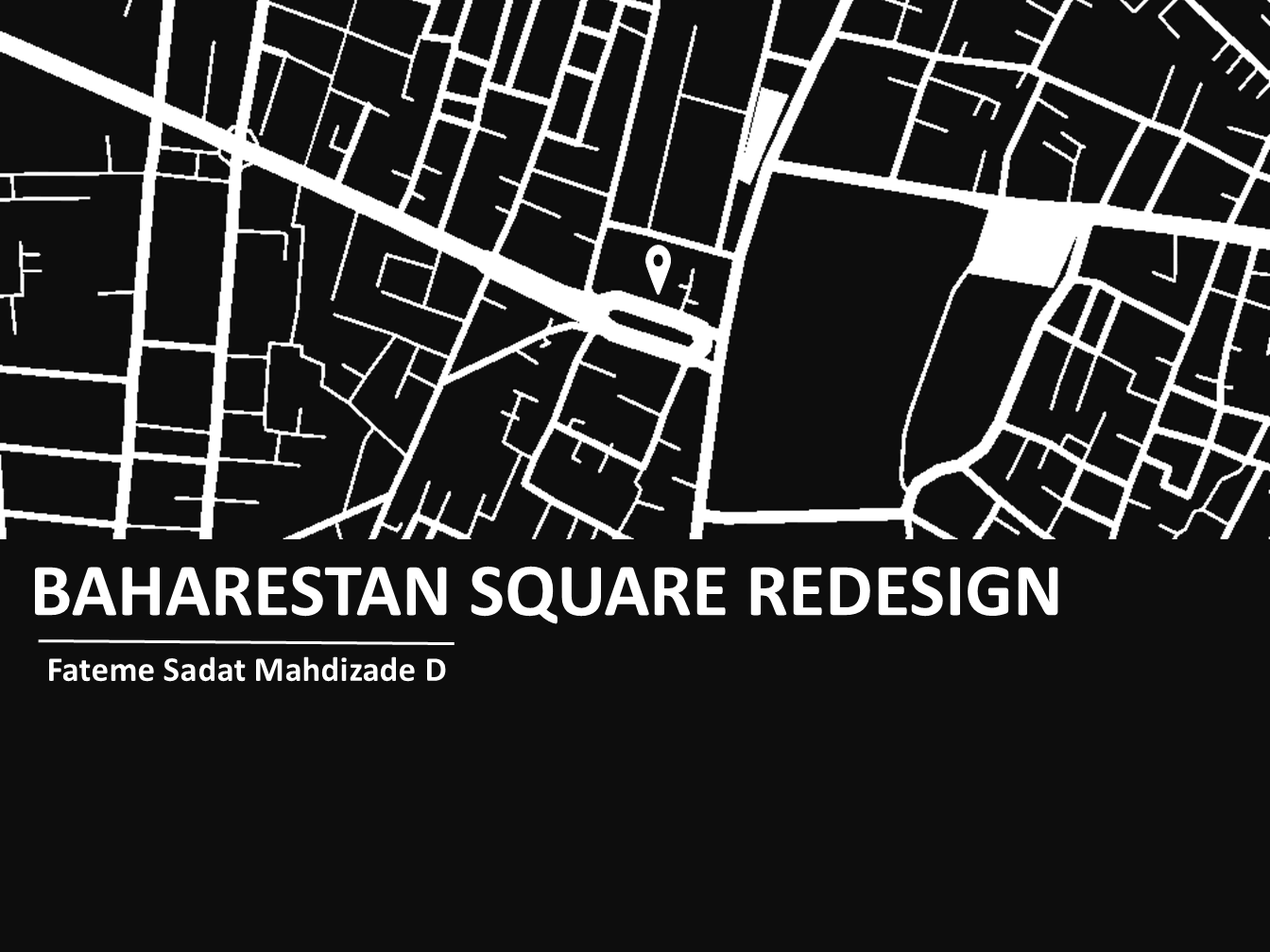
The redesign of Baharestan Square is presented as an academic study focusing on the challenges of reinterpreting a historical urban space within the contemporary context of Tehran. The project investigates the spatial, cultural, and social values of the square and explores strategies to balance heritage conservation with the demands of modern urban life. Through analytical research and design experimentation, the proposal seeks to enhance the square’s role as a civic landmark while addressing issues such as accessibility, public gathering, and spatial identity. This academic approach not only redefines Baharestan Square as a dynamic public space but also reflects on broader architectural questions regarding the dialogue between tradition and modernity in Iranian cities.
The redesign of Baharestan Square has been developed through an academic approach that draws on international theories of urban design, particularly the principles discussed in “Designing Urban Squares” by Murat Z. Memluk. This reference provided insights into the historical evolution, social functions, and design strategies of urban squares, which guided my analysis and design decisions. By reflecting on these concepts within the specific context of Tehran, the project reinterprets Baharestan Square as a multifunctional public space that balances historical identity with contemporary urban needs.
Reference:
Memluk, M. Z. (2013). Designing Urban Squares. In Advances in Landscape Architecture (Chapter 19). IntechOpen.
Link: https://www.intechopen.com/chapters/45404
DOI: 10.5772/55826
Pre-Design Phase
Step-01
History of Baharestan Square
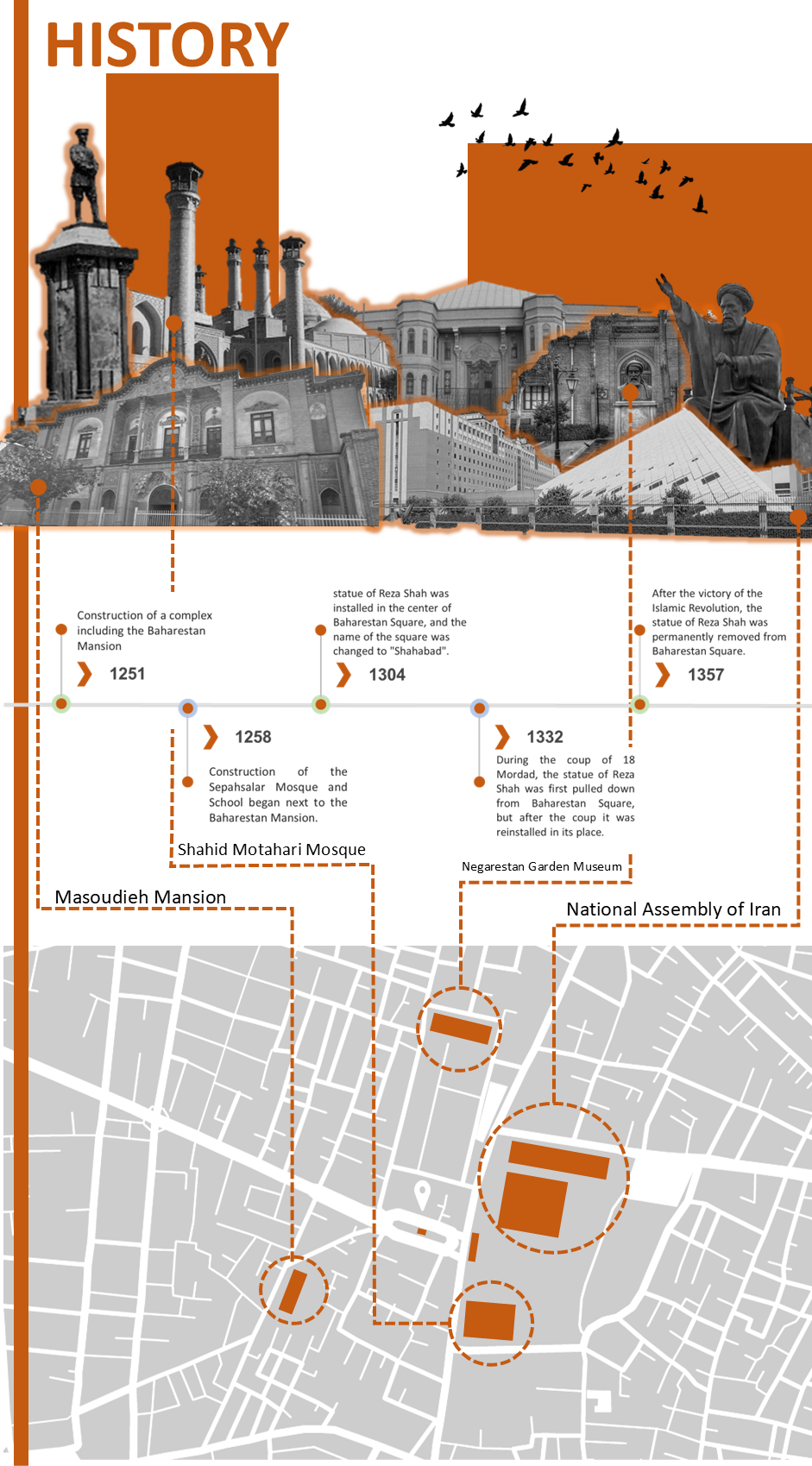
Baharestan Square, established during the Qajar era, has long been a central stage for political, social, and cultural life in Tehran. Originally designed as a public gathering space, the square witnessed many historic events, including constitutional movements, political demonstrations, and public celebrations. Its location at the heart of Tehran made it a focal point where the social, political, and cultural dynamics of the city intersected. Over time, the square has evolved but continues to retain its significance as a hub of civic life.
Significant Landmarks Around the Square
1. Negarestan Garden (Qajar Era, early 19th century)
A former royal garden, Negarestan reflects Persian garden traditions with its courtyards and water features. It also hosted important political and artistic events, shaping Tehran’s cultural memory.
2. Masoudieh Mansion (Late Qajar, 1870s)
Masoudieh Mansion combines Persian and European architectural elements. Historically, it served as a cultural hub and housed one of Tehran’s first public libraries.
3. Old Parliament Gateway (Sardar-e Qadimi, early 20th century)
This gateway symbolizes the Constitutional Revolution and early political reforms, blending traditional Persian and modern architectural influences.
4. New Building of the Islamic Consultative Assembly (Mid 20th century)
The modern Parliament building emphasizes authority and continuity, illustrating the evolution of political architecture in Tehran.
5. Shahid Motahhari Mosque (formerly Sepahsalar, late 19th century)
One of Tehran’s largest religious monuments, the mosque reflects Persian and Ottoman influences and has been a center for religious and cultural activities.
Step-02
- AREAS FUNCTION
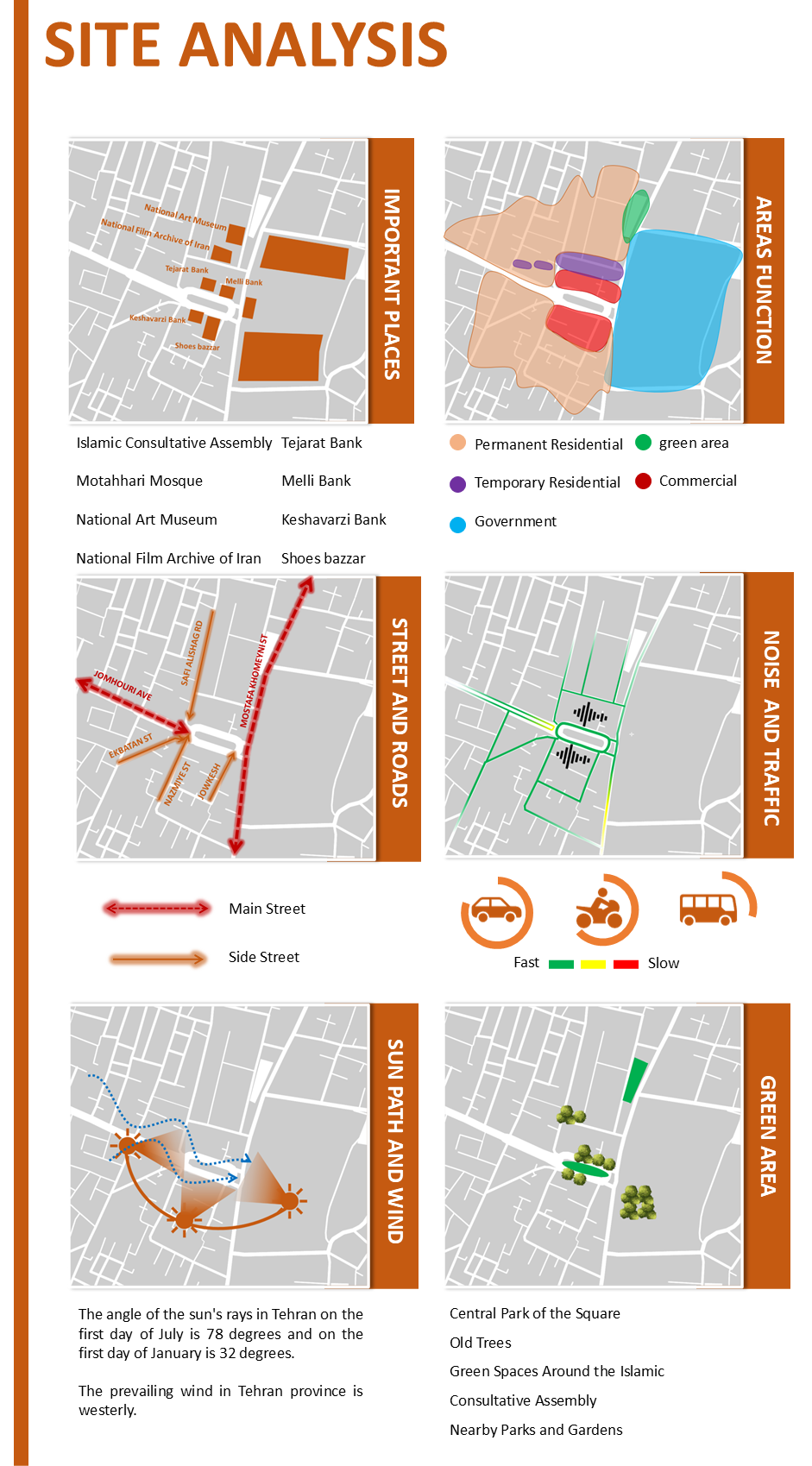
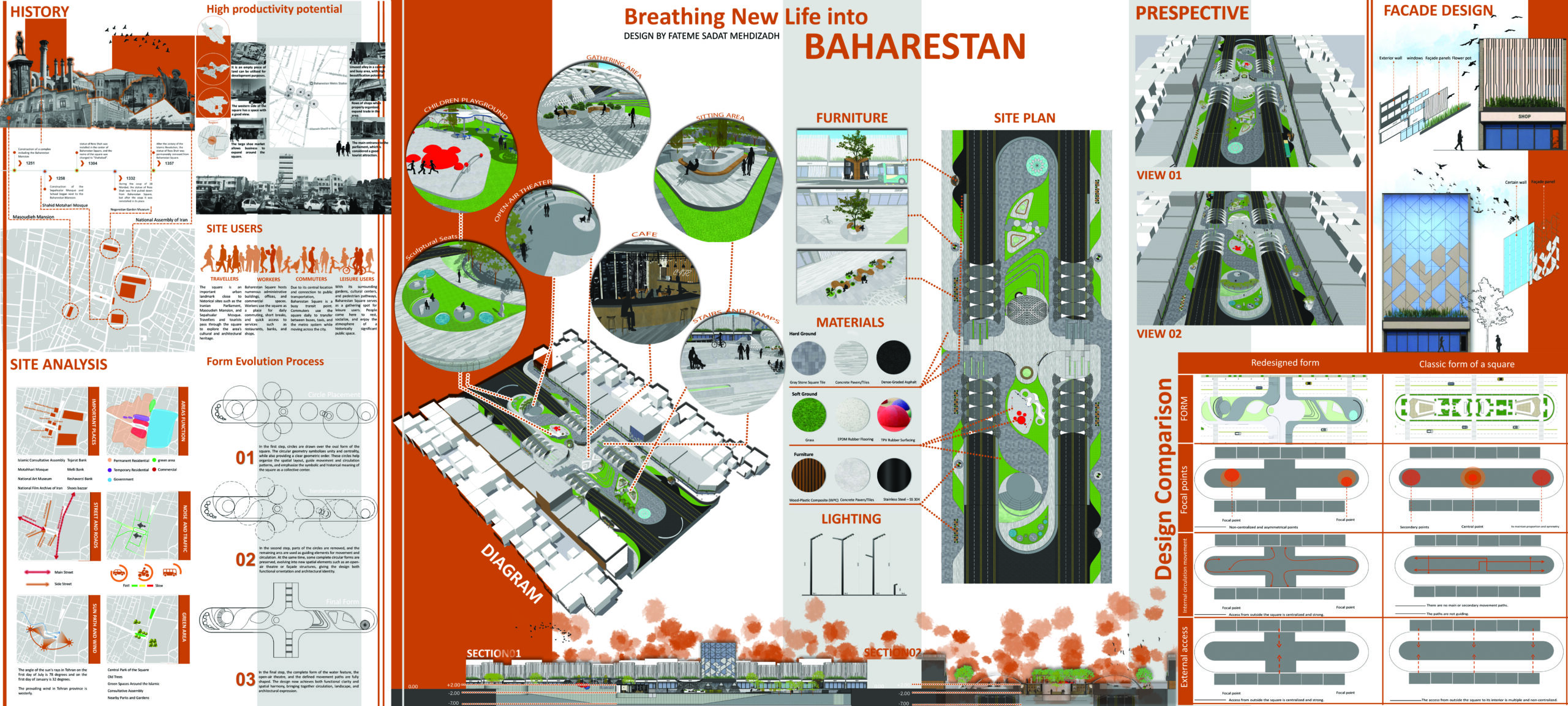
The function of the spaces around Baharestan Square mainly includes commercial spaces and government spaces dedicated to the parliament and banks. The blocks further away are dedicated to temporary and permanent residences.
-
SUN PATH AND WIND
The angle of the sun’s rays in Tehran on the first day of July is 78 degrees and on the first day of January is 32 degrees.The prevailing wind in Tehran province is westerly.After that, the most important wind in the summer season blows from the south and from inside the desert towards Tehran city.
-
NOISE AND TRAFFIC
light Traffic, despite its location in the city center and connection to important streets such as Jomhuri, Mojahedin-e-Islam, and Mustafa Khomeini streets, Baharestan Square faces a high volume of daily traffic of cars.
-
GREEN AREA
Central Park of the Square: This small but eye-catching park is a place for short stops, rest for passers-by, and taking souvenir photos.
Old Trees: Tall trees can be seen around the square and along some of the streets leading to it.
Green Spaces Around the Islamic Consultative Assembly: The Islamic Consultative Assembly building, located on the eastern side of the square, has a large green space in its grounds, which is also partially visible from the outside.
Nearby Parks and Gardens: Not far from Baharestan Square, there are several small parks and local green spaces that are available for residents and visitors to the area.
-
STREET AND ROADS
Jomhuri Eslami Street: This street is located on the western side of Baharestan Square and extends westward.
Safi Ali Shah Street: Located on the western side of Baharestan Square and extends southward.
Ekbatan Street: This street is located on the southern side of Baharestan Square and continues southward.
Mojahedin Islam Street: Located on the eastern side of Baharestan Square and extends eastward.
Ebn Sina Street: This street is located northeast of Baharestan Square and continues northward.
Mostafa Khomeini Street: This street is located southward of Baharestan Square and continues
-
IMPORTANT PLACES
Step-03
High Productivity Potential
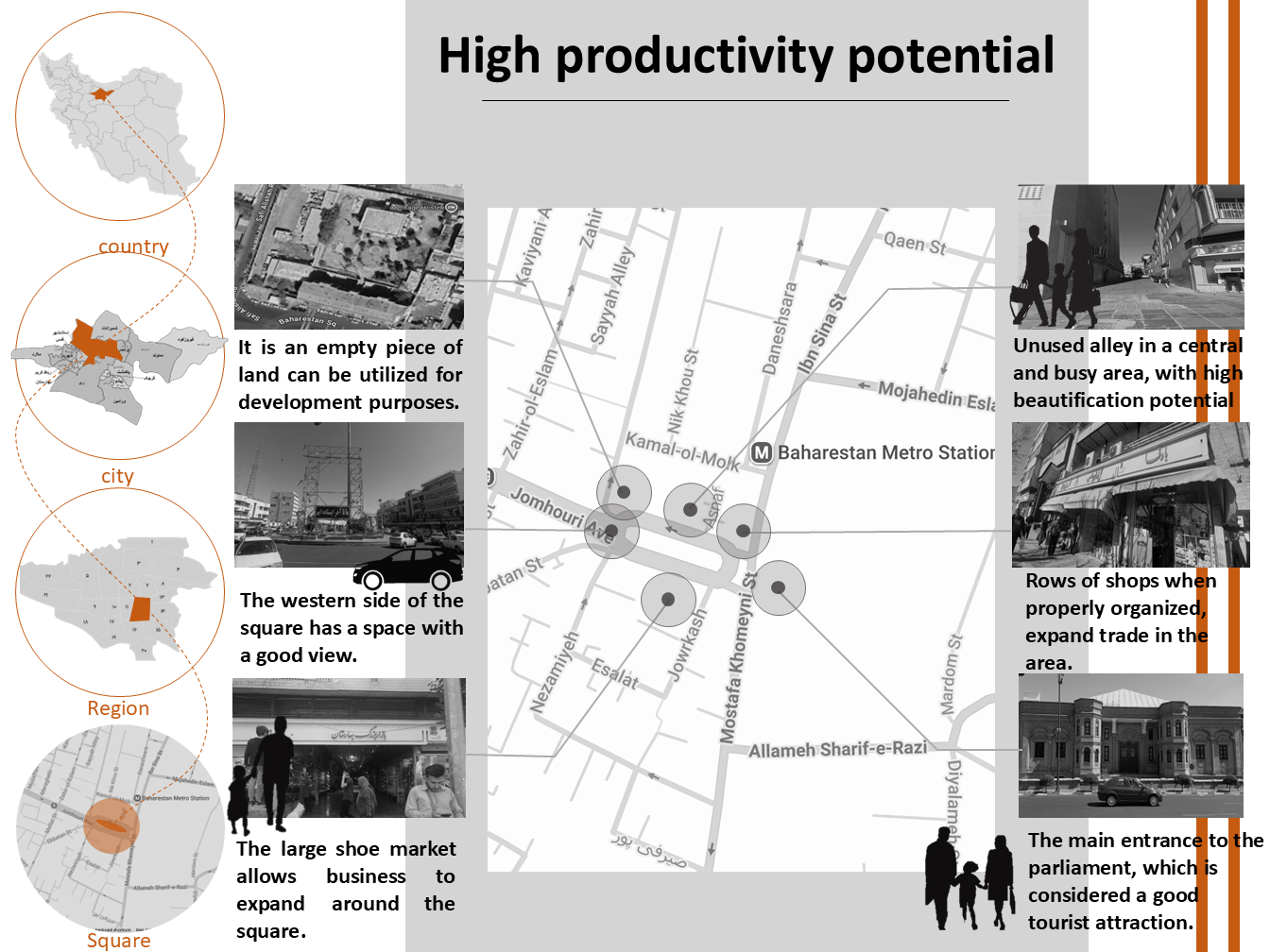
The term High Productivity Potential refers to urban spaces that possess a strong capacity for transformation and regeneration. These places often hold strategic value within the city, either because of their historical background, their connection to major urban networks, or their underutilized yet promising spatial qualities. The selection of such sites is not based merely on their current function, but rather on their hidden ability to evolve into more active, vibrant, and meaningful public spaces. By identifying these locations, the project aims to unlock their latent potential and guide them toward becoming drivers of urban vitality and cultural identity.
Design Phase
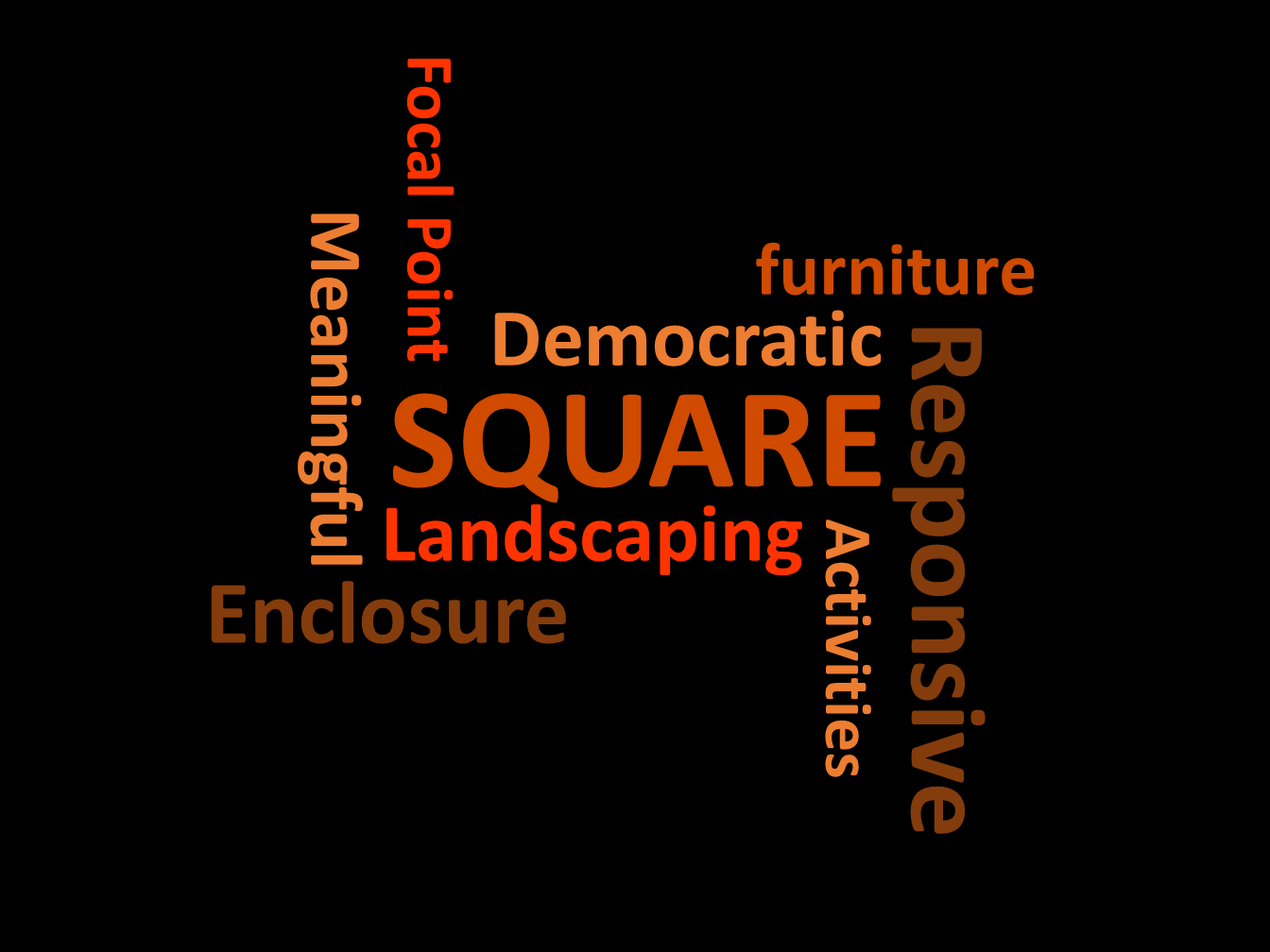
Key Concepts in Urban Square Design (Based on Memluk, 2013)
1. Meaningful
A public space should be meaningful, allowing people to connect the place with their own lives and the wider world. Meaningful spaces strengthen users’ sense of belonging and identity.
2. Focal Point
A focal point is an element that draws attention and defines the identity of the square. It can be a sculpture, fountain, building, or visual feature that enhances social interaction and aesthetics.
3. Democratic
An urban square should be accessible to all social, economic, and cultural groups. This ensures the space functions as a place for peaceful coexistence and social integration.
4. Furniture
Urban furniture includes benches, seating, lighting, trash bins, and signage. Proper selection and placement should provide functionality, safety, comfort, and visual harmony with the overall space.
5. Responsive
A square should respond to the needs of the community, providing opportunities for a variety of activities—relaxation, social interaction, play, or events—thereby increasing its use and vitality.
6. Enclosure
Enclosure refers to the spatial definition created by surrounding buildings or elements, giving a sense of order, security, and identity. It enhances users’ perception and experience of the space.
7. Activities
Activities are all the actions people carry out in a square, from social interaction and leisure to markets, performances, and ceremonies. A successful design accommodates diverse activities to keep the square lively and engaging.
Start Of Design
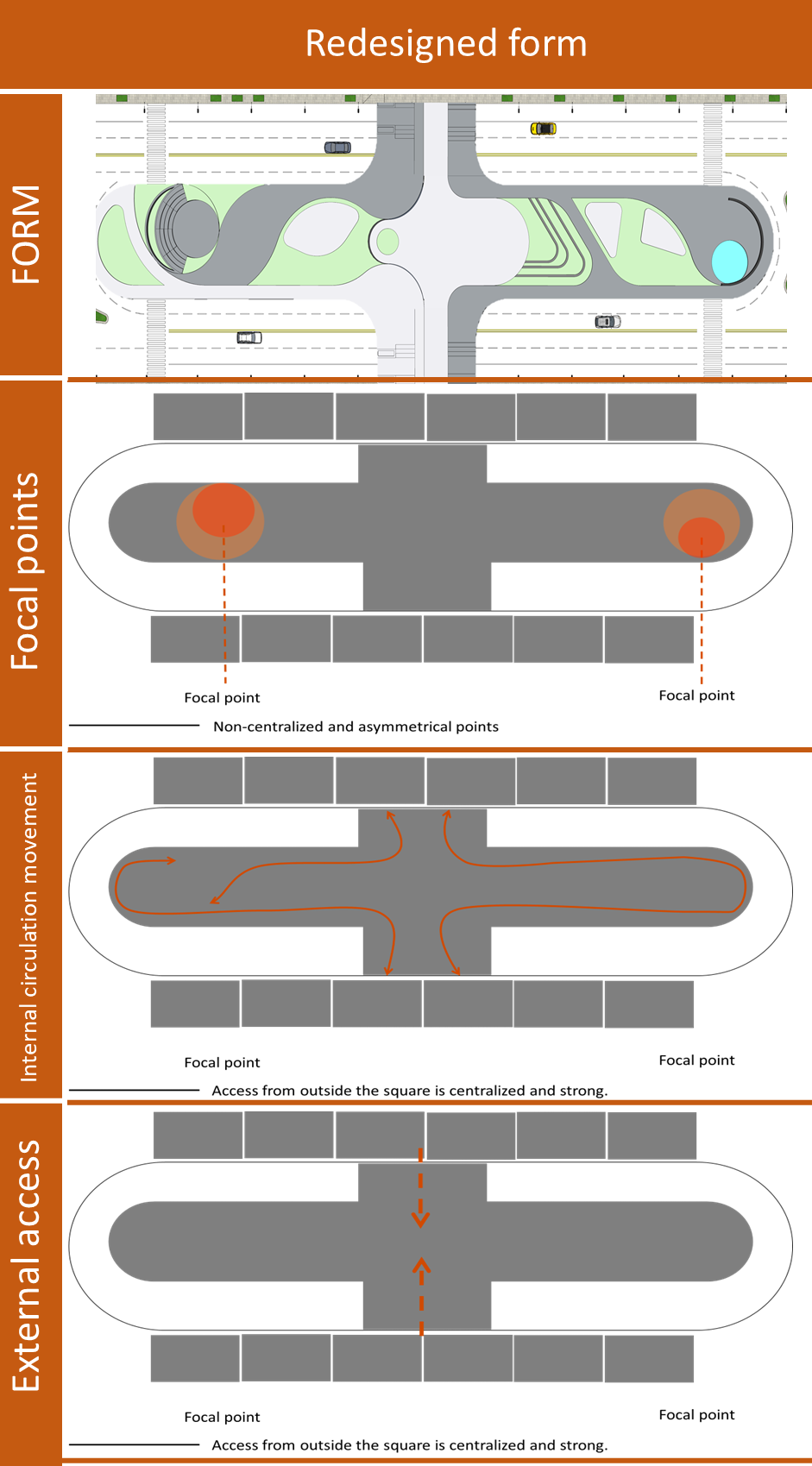
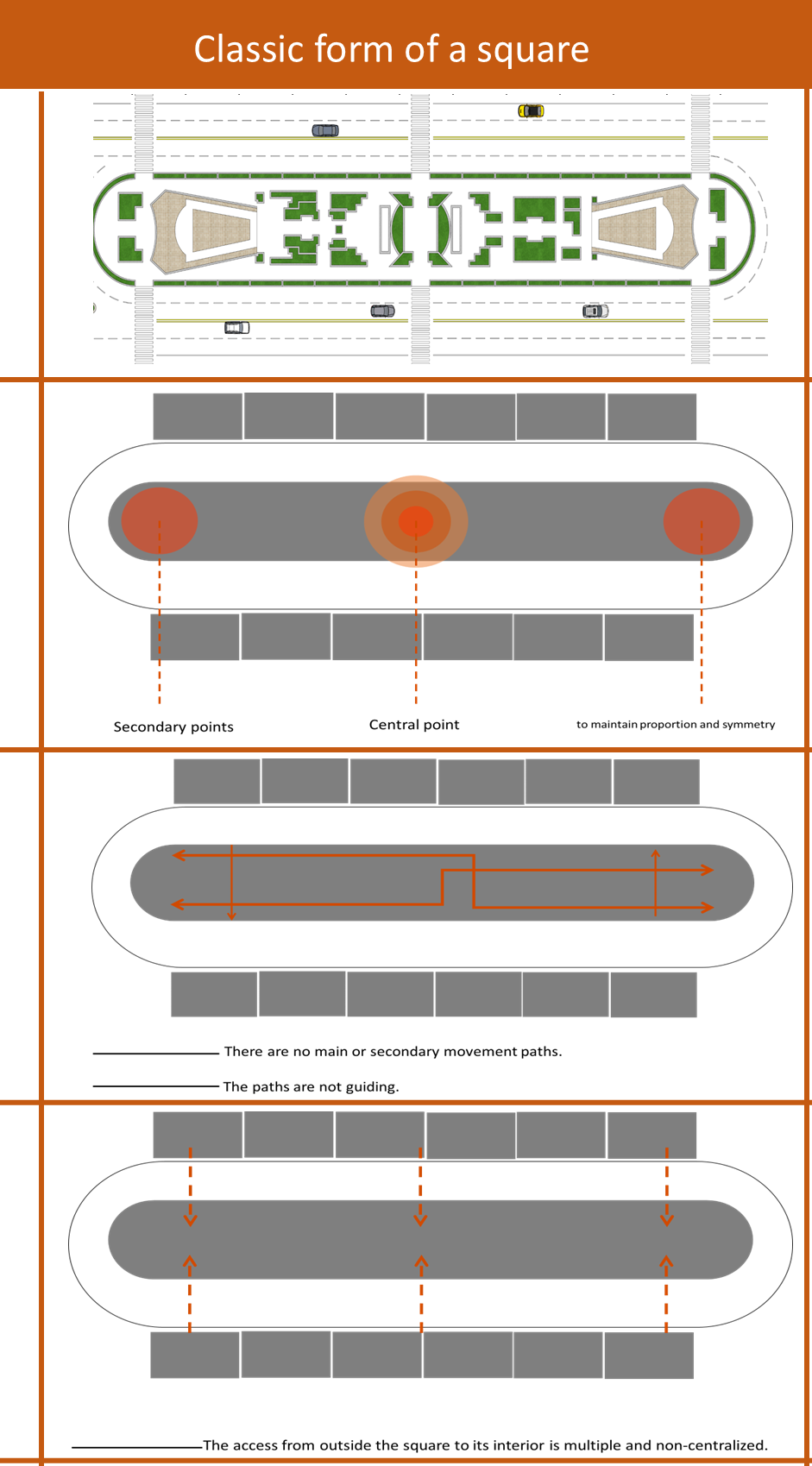
Design Comparison